Software engineering
What is Web3?
Alex de Pablos Lopez5 min
It is quite likely that, unless you have been hiding in a cave, you have heard about Web 3.
But it is also quite likely that even having read something about it, you have stayed the same, because it is difficult to find definitions that make the general public understand what Web3 is.
Web 3.0 represents the next step in the evolution of the web and aims to make the Internet smarter and we could also say fairer.
Let’s try to start with the basics, first understanding the evolution of the Web.
Web evolution
The web is a living entity and as such it is changing and evolving. New tools and strategies are being incorporated, which are arriving little by little and giving way to new stages.
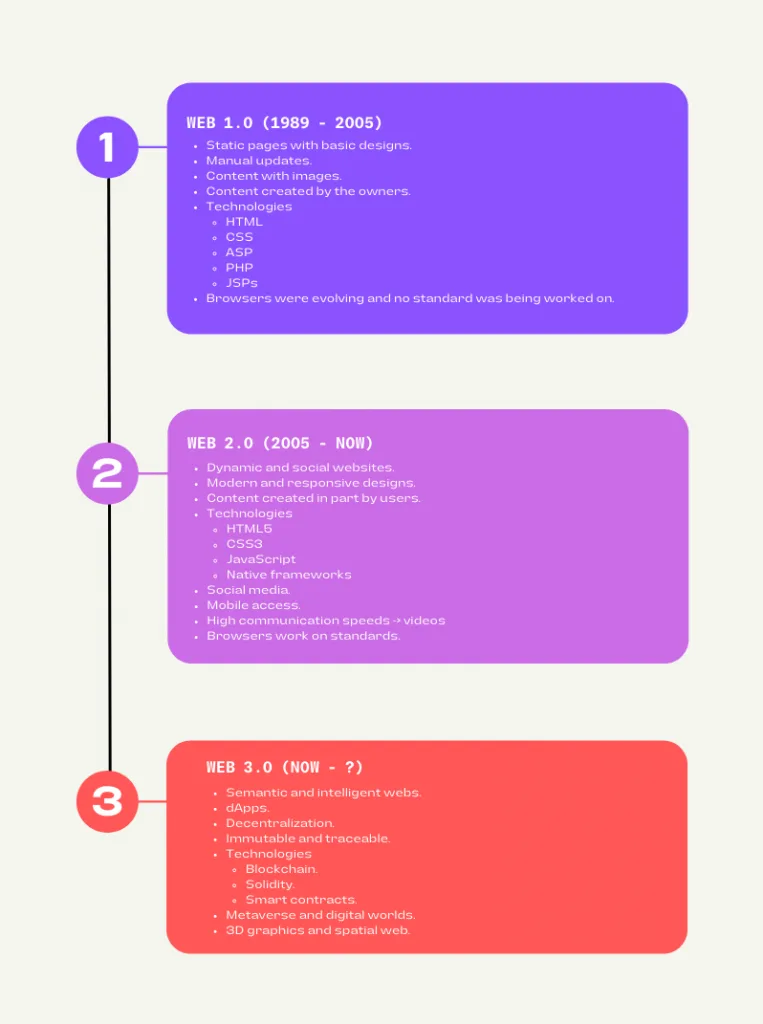
Web 1.0
Initial stage of the web, also known as read-only web.
Web 1.0 sites were mostly static, and their main goal was to make information available to the public.
Web 2.0
As web servers and speeds improved, the web stopped being so static and incorporated new features that led to this new Web 2.0.
This stage is also called the read-write web. The main change that led to this new stage was to put aside static websites, and begin to have dynamic content, which could be generated by the user.
The rise of social networks had a lot to do with this Web 2.0.
The term originated in 2004, the product of Tim O’Reilly’s conference on the future of the Internet.
One of the big changes at the heart of Web 2.0 is the move from creating software artifacts, which is what the PC revolution was all about, to creating software services. These are services that ultimately, if successful, will require operating, scaling and similar competencies.
Tim O’Reilly
I am pretty sure if I mention websites like Google Maps, Facebook, Twitter, YouTube, WordPress, they sound familiar to you, right? Well, they all belong to Web 2.0.
Today it can be said that it is still what we all know and with which we are most familiar.
Web technologies like HTML5, CSS3 and Javascript frameworks like ReactJs, AngularJs, VueJs and others allow users to generate new concepts, allowing users to contribute more to this Social Web.
Web 3.0
And we got to the one that brings us here. It is also known as read-write-execute web.
It coincides with the era of breakthrough in artificial intelligence, machine learning and virtual and augmented reality.
It can be said that we are one small step closer to machines understanding data in the same way that we do people.
Web 3.0 is highly decentralized, powered by machine learning and artificial intelligence, and uses a technology called Blockchain.
Users retain control over their information, and can sell or trade their data without losing ownership, risking privacy, or relying on intermediaries.
In this business model, users can log in to a website without their identity being tracked on the Internet.
Web 3 applications or dApps are developed on decentralized peer-to-peer networks like Ethereum.
These networks are developed, maintained and operated by their own users. There is no company behind them. Hence they are called decentralized.
They are self-organizing and have no single point of failure.
Whenever Web3 is talked about, cryptocurrencies come to the fore. You may be wondering why. And it is that a key to innovation in Web 3.0 is the digitization of assets through tokenization.
Tokenization converts assets and rights into a digital representation, or token, on a Blockchain network. Cryptocurrencies and fungible tokens are forms of digital currency that can be easily exchanged online, driving a new business model that democratizes finance and commerce.
Non-Fungible Tokens (NFT) are units of data that represent unique assets, such as avatars, digital art, or trading cards, that users can own and monetize for their own benefit.
Anyone who wants to help create, control, maintain or improve one of these Web 3 projects usually receives an incentive in the form of tokens.
The services offered under these new protocols range from computing, storage, identification, hosting… and another series of services that certain providers offer in the cloud today.
What makes Web3 so unique?
Web 3 was born to solve the most serious problem with Web 2.0, which is the collection of personal data by private networks, which they later sell for commercial purposes and which are also the main target of hackers who always try to steal them. a security breach is found.
Web 3 is decentralized, which means that it is not controlled by a single organization. The applications that are created on top of it (dApps) are also open.
Web3 features
Decentralization
It is one of the keys to Web 3.
The data is stored in a decentralized way instead of as before, where it is normally stored in data centers run by private companies.
Users maintain ownership of their data and digital assets and can securely log in over the Internet without being tracked.
Blockchain
Technology on which the Web is based 3.
With Blockchain technology, user data is protected and encrypted. This prevents their commercial use by large companies that today are the ones that control them.
Semantic web
It allows users to create, share and connect content through the search and analysis of data and the ability to understand the real meaning of words.
Until recently, when in a search engine like Google the user entered something like ‘How tall is an elephant’, what was given as an answer were pages that contain that keyword.
Now it goes further, analyzing the semantics of what the user asks, and being able to answer with the standard measure of a common elephant.
3D graphics
3D graphics are widely used in Web 3.0 websites and services, such as online games, e-commerce, and portfolio websites.
Take a look at this website to see an example of what I’m talking about.
Artificial intelligence
The use of natural language processing and AI in Web 3 brings machine understanding closer to human understanding.
This allows faster results, but above all more relevant.
We are already seeing certain websites suggest products or videos to users based on previous searches. This is part of this whole new paradigm. But the thing will go much further.