Software engineering
What is Blockchain
Alex de Pablos Lopez6 min
Despite being a technology from 1991, since the famous Bitcoin cryptocurrency used Blockchain as the main part for its operation, it has been gaining more and more fame until today it has become the center of conversation in practically any innovation event and technology.

Let’s see if in this article I can summarize the most important concepts so you can understand what Blockchain is and how it works.
What Blockchain is NOT
There is a lot of blablabería around Blockchain and in fact many times it is heard wrongly talked about in media that are supposed to be reliable.
So I want to start this article with what I think is most important for you to know; what Blockchain is NOT. Let’s go there!
-
It is not a cryptocurrency.
-
It is not a programming language.
-
It is not a cryptographic algorithm.
-
It has nothing to do with Artificial Intelligence or Machine Learning.
-
It is not a framework.
What is Blockchain?
As the name suggests, it is a Blockchain. That is, a set of blocks that are linked together.
Certain information is stored in these blocks. Usually a set of transactions.
Imagine that you make a transfer of Bitcoins to your cousin, and then you receive another certain amount from your best friend. These two movements are considered transactions that will be found in some block within the chain of blocks.
At its core, Blockchain is a distributed digital ledger that can store data of any kind, not just financial transactions.
The Blockchain is an incorruptible digital ledger of economic transactions that can be programmed to record not just financial transactions but virtually anything that might have value.
Don & Alex Tapscott
You may be wondering… ‘Very good, but… this is what my bank has, right? I can always access and see all the movements made in my account’ And you’re right, but…
… What makes Blockchain unique as a storage medium is that it is totally decentralized in a network of distributed nodes on the Internet, unlike what is happening in the financial system today, for example, where yes, of course you can access the movements of your account (of course!) but everything resides and is centralized in your bank. He is the owner and lord of everything.
In Blockchain, all the nodes of the network maintain an identical copy of the entire chain of blocks.
In this way, the trust of any centralized entity that dictates the authenticity and integrity of the information is not needed.
Virtually all cryptocurrencies use Blockchain to store the information necessary for their operation. But as you already know, Blockchain is NOT a cryptocurrency, but the technologies that they use.
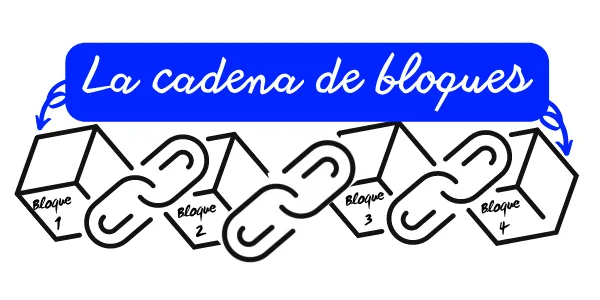
You will find a lot of information where Blockchain is classified as “new technology”. Nothing is further from reality. Its birth and acceptance dates back to 1991, in the Scott and Stornetta publication “ How to Time-Stamp a Digital Document (opens in a new tab) ”.
Another noteworthy publication, closer in time, is that of Satoshi Nakamoto in 2009 ” Bitcoin: A Peer-to-Peer Electronic Cash System (opens in a new tab) ” where the man behind said pseudonym describes the Bitcoin system, based on Blockchain.
How Does Blockchain Work?
The way new blocks are created is key to why the Blockchain is considered highly secure.
Most nodes must verify and confirm the legitimacy of new data before a new block can be added to the Blockchain.
There are 5 key concepts that make up the basis of Blockchain.
-
Hash cryptographic algorithm.
-
Immutability of the accounting book.
-
Red P2P (peer to peer).
-
Consensus protocols.
-
Block Validation or Mined.
Let me go into a little more detail on each of them.
Hash cryptographic algorithm
A hash is a cryptographic function that converts an input into a text string of a given length.
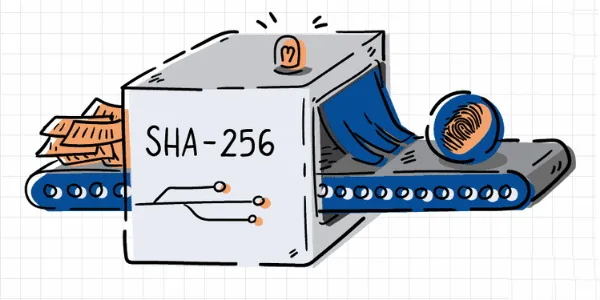
The grace of these algorithms is:
-
Every minimally different input will have a different output.
-
It is deterministic, that is, the same input will always have the same output.
-
The conversion is one-way, which means that given the output it is not “possible” to know the input that generated it. Note: it is possible, but it would require such a high computational level that today they are at least considered one-way.
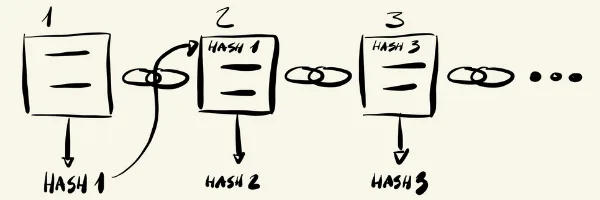
Blockchain uses the Hash as a mechanism to identify a block.
Each block in the chain includes the hash of the previous block.
Immutability of the ledger
Precisely because of the last sentence of the previous block, it is not possible to modify any block without changing the entire chain.
That is why the chain is said to be immutable.
If someone wanted to modify, add or delete any transaction in the first block, Hash 1 would change, and since this value is included in block 2, Hash 2 would too… and this would propagate throughout the chain.
Red P2P
The network is key in Blockchain to guarantee the security and integrity of the information.
In addition, the decentralization of Blockchain means that no external entity is needed to guarantee the integrity of the data.
Each user of the network has a copy of the block chain and they communicate the information of new transactions to the entire network.
That is why it is not possible for anyone to alter the information on the block chain, since it is not stored centrally, but by the entire network.
Consensus protocols
Network users need to reach a consensus on the integrity of the chain before adding any new blocks.
Therefore, every time a node creates a new block, all users will have to validate using a common protocol.
The two most common protocols are Proof of Work (PoW) and Proof of Stake (PoS).
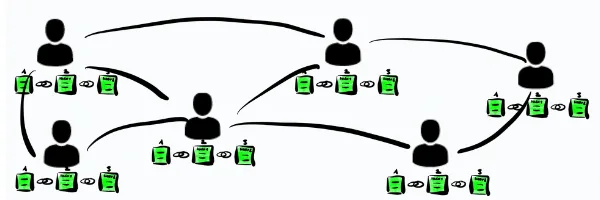
Each node in the network checks that the new block meets the requirements stipulated by the consensus mechanism, and if it is valid, it is included in the chain and new blocks continue to be added.
In case two users have two different strings and both are apparently valid, the longest one will be chosen.
Consensus mechanisms are another key in Blockchain.
Validation of block or mined
The term “mining” refers to the act of meeting the requirements of the consensus mechanism to add a new block to the Blockchain.
For example, PoW generally requires the user to create a block with certain restrictions on its hash code. These restrictions define the difficulty of the network.
Since the hash code is unpredictable, miners must try any possible combination by brute force to meet the stated requirements.
Once a mining node finds the solution to the PoW problem, it adds the block to the chain and all other nodes verify the validity of the PoW according to their consensus protocol.
If the block is legitimate, they will include it in their own local copies of the Blockchain, and the miner will receive their reward.
Public vs Private Blockchain
In a public Blockchain, anyone can participate, reading, writing or auditing the data on the Blockchain. It is very difficult to alter the transactions recorded on a public Blockchain as no single authority controls the nodes.
A private Blockchain is controlled by an organization or group. It is the group that decides who is invited to the system and has the authority to modify the Blockchain. It is perhaps more similar to an internal data storage system, except that it is spread across multiple nodes to increase security.